Juan Guillermo Villasana López
1891–1959 · Mexican
Aeronautical engineering
WHY YOU SHOULD KNOW THEM
Designed the Hélice Anáhuac propeller and became the first Chief of Mexico's Civil Aeronautics Department
THEIR STORY
Juan Guillermo Villasana López studied mathematics, physics, and aerodynamics at the Scientific and Literary Institute of Pachuca starting in 1910, while also designing and testing his own aircraft on local haciendas as a young man — real hands-on engineering, not just classroom theory, from the very beginning. In 1909 he helped co-found Mexico's first aeronautical organization, La Sociedad de la Aviación, and by April 1910 he had flown to an altitude of 700 meters over Pachuca. In 1912, he built five Deperdussin-type aircraft for the Mexican Army, the first of which he named "Latinoamérica." He went on to earn a formal aeronautics engineering degree from the American Aviation School in Buffalo, New York, in 1918, then specialized further in Liberty aircraft engines at Kelly Field, Texas. His most important technical achievement solved a real, specific engineering problem: aircraft performance at Mexico's high-altitude cities, where thinner air meant propellers designed for sea level simply didn't generate enough thrust. In 1915, drawing on his family's woodworking traditions, Villasana designed and hand-built the Hélice Anáhuac — a laminated-wood propeller — at Mexico's National School of Arts and Crafts, iterating on blade shape and pitch until it produced meaningfully more thrust in thin, high-altitude air. He later took the design to Japan, where he set a world altitude record of 19,750 feet in 1919. Rather than sell the patent abroad for personal profit, he donated it to Mexico. His other achievements stack up: he flew the world's first registered international airmail flight, from Pachuca to Mexico City, on July 6, 1917. He built a working helicopter in 1922, decades before helicopters became a practical technology. In 1928, he became the first Chief of Mexico's new Civil Aeronautics Department, formally founding the institutional framework for Mexican civil aviation. In 1955, he received the Emilio Carranza medal in recognition of that role. He died in 1959, and Pachuca's airport carries his name today.
WHAT THEY ACTUALLY DID
As an aeronautical engineer, Villasana designed and hand-built propeller blades from laminated wood, testing and adjusting their shape and pitch to solve a real aerodynamic problem: generating enough thrust in the thinner air of high-altitude airports, the same density-altitude problem taught in aviation ground school today.
WHAT YOU'RE LEARNING THAT CONNECTS
The Hélice Anáhuac was built specifically to solve density-altitude performance loss — exactly the concept students learn when studying how thinner, high-altitude, or hot-day air reduces an aircraft's performance.
DID YOU KNOW?
He donated his propeller patent to Mexico rather than selling it abroad for personal profit.He built a working helicopter in 1922, decades before helicopters became a practical aircraft type.He flew the world's first registered airmail flight, from Pachuca to Mexico City, in 1917.
SOURCES
Secretaría de la Defensa Nacional (SEDENA), official biography; Wikipedia (ES); Revista Inclusiones academic article
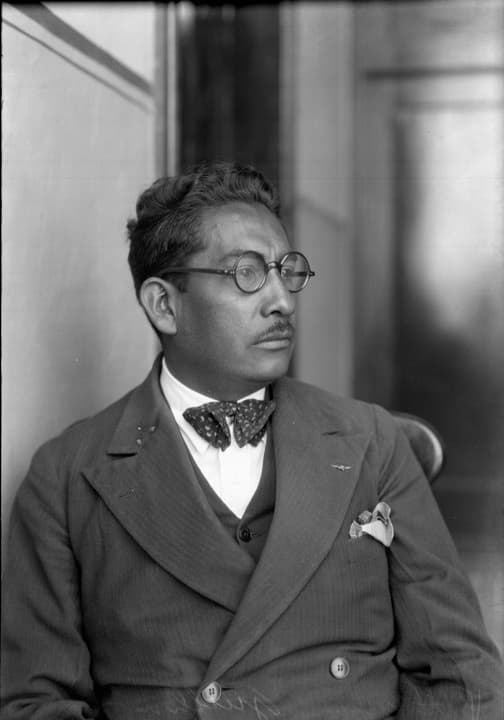
Photo: Fototeca Nacional, INAH — Archivo Casasola · CC BY-NC-ND 4.0 · Source