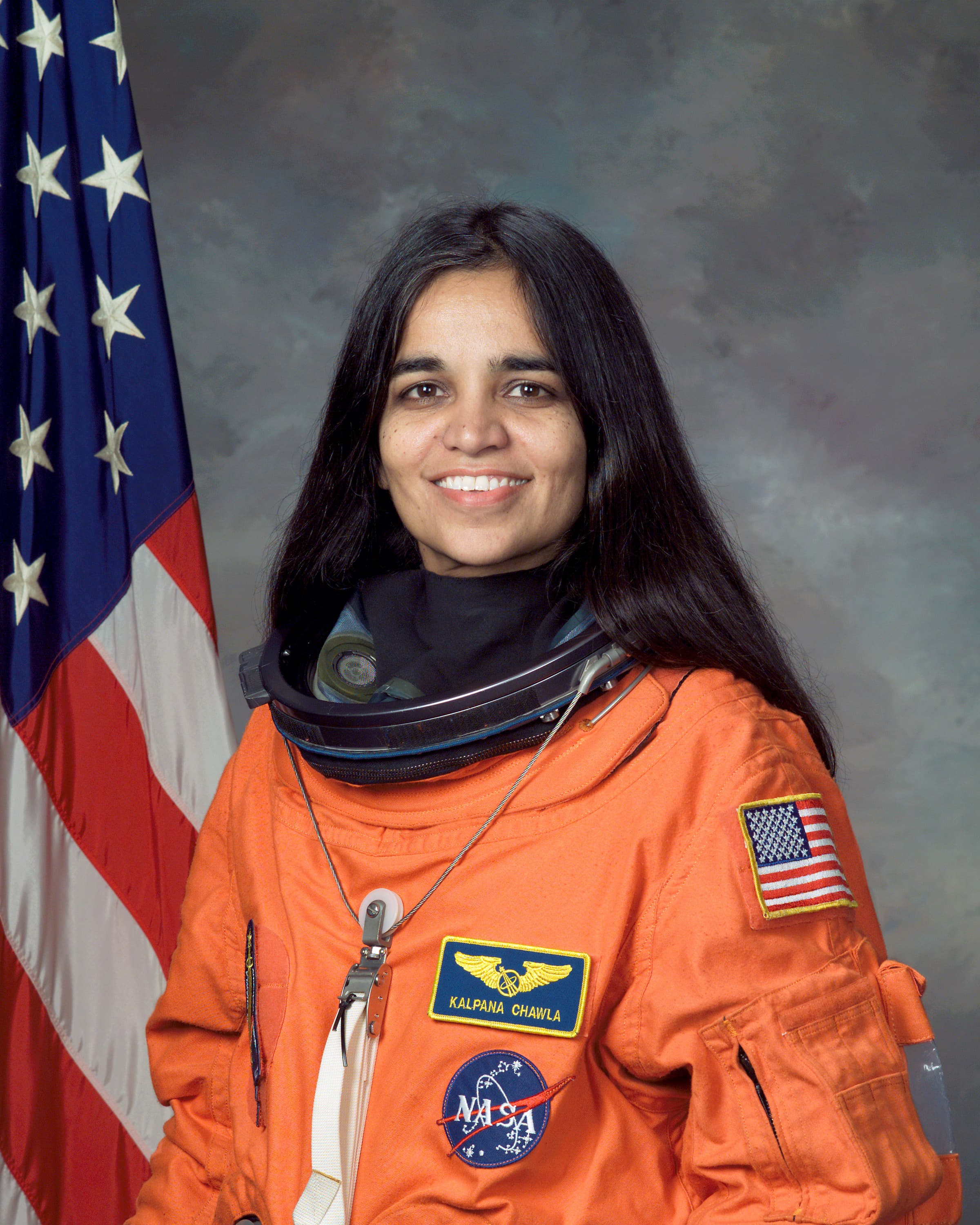
Kalpana Chawla
1962–2003 · American (born in India)
Aerospace engineering and spaceflight
WHY YOU SHOULD KNOW THEM
First woman of Indian origin in space (1997); aerospace engineer specializing in computational fluid dynamics
THEIR STORY
Kalpana Chawla earned a bachelor's degree in Aeronautical Engineering from Punjab Engineering College in India in 1982, then continued her education in the United States: a master's degree from the University of Texas at Arlington in 1984, and a PhD from the University of Colorado Boulder in 1988, becoming a naturalized U.S. citizen along the way. Before she ever became an astronaut, Chawla built a genuine research engineering career. At NASA Ames Research Center from 1988 to 1993, she conducted computational fluid dynamics research on V/STOL (vertical/short takeoff and landing) aircraft — essentially, using computer simulations to model how air flows around an aircraft during the complex transition between vertical and horizontal flight, similar to how a Harrier jet operates. She then worked as a vice president and research scientist at Overset Methods Inc. from 1993 to 1994, continuing that same specialized computational aerodynamics work in industry before NASA selected her as an astronaut. She flew her first spaceflight in 1997 aboard STS-87, becoming the first woman of Indian origin to travel to space. Her second mission, STS-107 in 2003, ended in tragedy: during reentry on February 1, 2003, Space Shuttle Columbia broke apart, killing all seven crew members including Chawla. The subsequent investigation determined that a piece of foam insulation had broken off during launch and damaged the wing's heat shield — a specific, identifiable engineering failure, not an unexplained accident. She was posthumously awarded the Congressional Space Medal of Honor in 2004.
WHAT THEY ACTUALLY DID
As a computational fluid dynamics researcher, Chawla used computer simulations to model exactly how air flows around an aircraft in complex conditions — like a jet transitioning between vertical and horizontal flight — the same kind of simulation-based modeling that underlies modern aircraft and spacecraft design.
WHAT YOU'RE LEARNING THAT CONNECTS
The foam-strike failure that caused the Columbia disaster is a sobering, real example of why every component of an aircraft or spacecraft's structure — even ones that seem minor, like insulation — matters to overall flight safety.
DID YOU KNOW?
She was the first woman of Indian origin to travel to space, in 1997.She was posthumously awarded the Congressional Space Medal of Honor in 2004.
SOURCES
Wikipedia
Photo: NASA · Public domain · Source